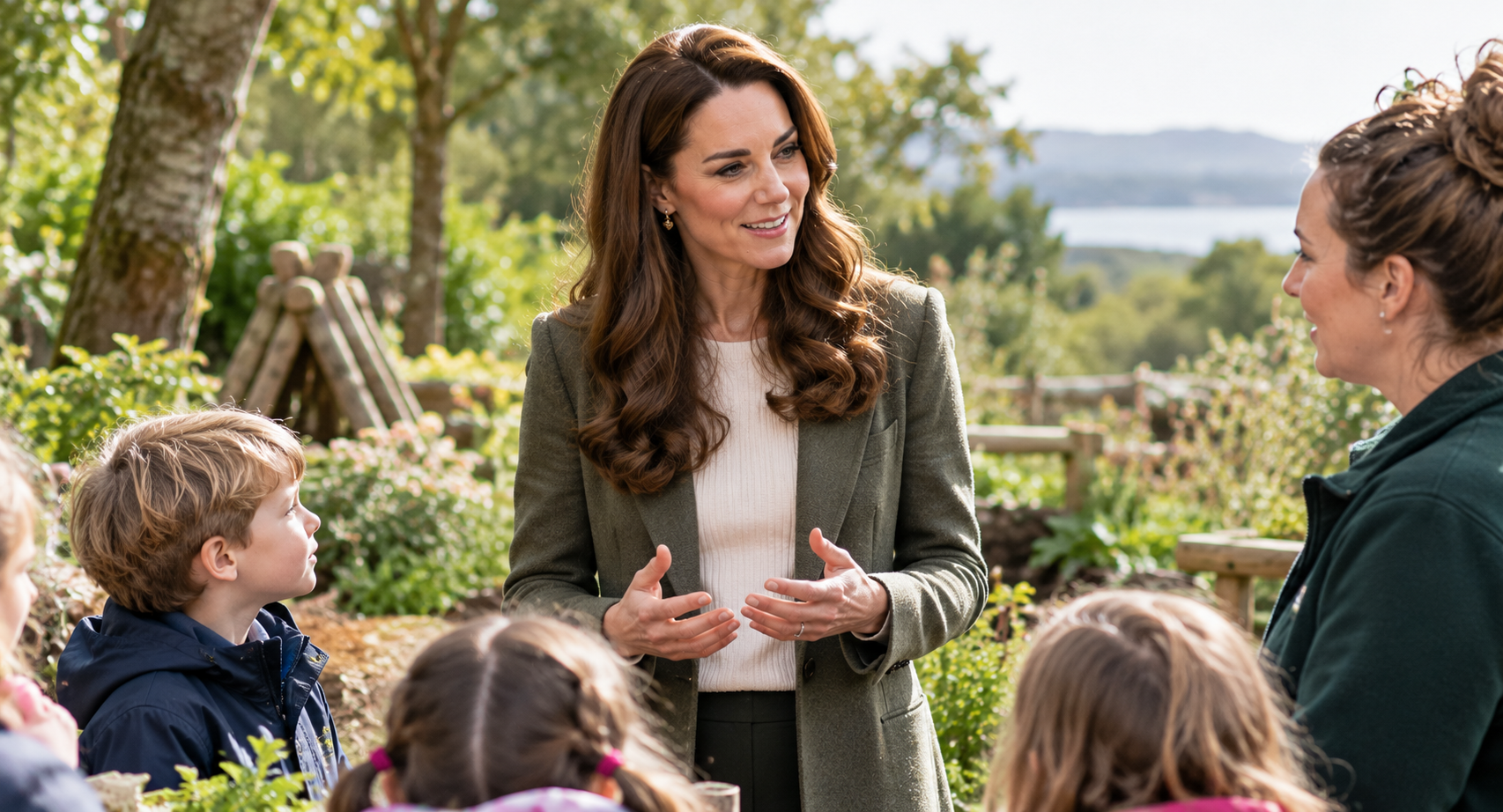
Kate Middleton has spent much of her public work focusing on the earliest years of childhood, and her latest initiative brings another subject into that conversation: nature. On October 16, 2026, The Royal Foundation Centre for Early Childhood announced a new project exploring how nature-rich environments, combined with nurturing relationships, could support the social and emotional development of babies and young children.
The announcement followed The Princess of Wales’s visit to Cornwall, where she learned more about nature-based learning during the earliest years of life. The project is being developed with The Duchy of Cornwall as a founding partner and will bring together academics, early-years practitioners, charities, and environmental organizations. The Royal Foundation Centre for Early Childhood explains the new nature project in its official announcement.
The subject is particularly relevant to families because outdoor time does not have to mean expensive trips, elaborate activities, or long days in the countryside. A garden, local park, balcony with plants, community green space, or simple walk can create opportunities for children to notice their surroundings and interact with the adults around them.
For readers who regularly follow Pregnant Kate’s Royal Baby coverage, the initiative provides a different perspective on Kate’s work with children. Rather than focusing on pregnancy predictions or royal family speculation, it looks at a current project connected to childhood development, family life, and the environments in which children grow.
What Is Kate Middleton’s New Nature Initiative?
The new initiative is focused on understanding the relationship between nature-rich environments and children’s social and emotional development. According to the Centre for Early Childhood, the project will explore how nature, alongside nurturing relationships, can help babies and young children build skills that contribute to lifelong wellbeing.
The project builds on Kate’s broader early-childhood work. The official Royal Family overview of The Princess of Wales’s early-years work describes her longstanding interest in the experiences and relationships that shape development during the earliest years of life.
This latest project does not suggest that nature alone determines how a child develops. Instead, it is examining how environments can work together with relationships, experiences, and other aspects of early childhood. That distinction is important because children develop through many interacting influences.
Why Nature Is Becoming Part of the Early-Childhood Conversation
Nature can provide an environment in which young children explore, move, observe, experiment, and interact with other people. A walk through a park might involve watching birds, collecting leaves, noticing different textures, or simply walking alongside a parent while talking about what is happening around them.
UNICEF has also highlighted the importance of outdoor play. Its discussion of the importance of outdoor play notes that research has associated outdoor play with physical, mental, emotional, and learning benefits for children.
That does not mean every outdoor experience needs to become a structured educational lesson. In fact, one of the appealing aspects of nature-based experiences is that children can learn through ordinary exploration. A child watching an insect, touching tree bark, helping water plants, or looking at clouds may be engaging with the world in a way that encourages curiosity.
Kate’s Longstanding Interest in Early Childhood
The new nature project is not an isolated royal initiative. It fits into a much broader body of work that Kate has developed around early childhood.
The Royal Foundation Centre for Early Childhood was established in 2021 after Kate had spent years exploring the importance of children’s earliest experiences. The Centre says its work is intended to increase awareness and action around early childhood, with particular attention to the period from pregnancy through age five.
The Centre’s official history and mission explains how the organization focuses on the conditions and relationships surrounding babies, young children, and their families.
That broader mission helps explain why nature has become an area of interest. A child’s environment is not separate from development. Where children play, who they interact with, what they can explore, and how adults respond to their curiosity can all form part of their everyday experiences.
Nature, Relationships, and Social Development
 One of the most interesting aspects of the new project is that it does not focus on nature in isolation. The Centre specifically describes the relationship between nature-rich environments and nurturing relationships.
This matters because an outdoor experience can become more meaningful when a child shares it with a responsive adult. A parent might point out a bird, answer a child’s question, encourage exploration, or simply allow the child to lead the activity.
UNICEF’s early childhood development resources similarly emphasize responsive caregiving and opportunities for children to interact with their environments. These interactions can include talking, playing, exploring, and learning together.
The important point is that outdoor time can create opportunities for connection. A walk does not have to be educational in a formal sense to become a valuable family experience.
What Nature-Based Learning Can Look Like
Nature-based learning can take many forms depending on a child’s age and the environment available to the family. For a toddler, it might involve walking through a garden and identifying flowers. For an older preschool child, it might involve looking for insects, observing weather, planting seeds, or creating a simple nature collection.
The goal does not necessarily need to be academic achievement. Children can learn through movement, sensory experiences, questions, imagination, and social interaction.
The World Health Organization’s guidelines for children under five emphasize the importance of physical activity, reduced sedentary time, and adequate sleep as part of healthy development. Active play can take place in many settings, including outdoor environments.
This makes outdoor activities useful as part of an overall family lifestyle rather than something that needs to be treated as a special event.
How Families Can Bring More Nature Into Everyday Life
One of the most practical questions raised by Kate’s initiative is how ordinary families can provide more opportunities for children to experience nature.
A family does not necessarily need access to a large garden or countryside. Small, consistent experiences can be enough to introduce children to natural surroundings.
- Take a neighborhood walk: Encourage children to notice trees, birds, flowers, clouds, or changes in the weather.
- Visit a local park: Allow children time for unstructured movement and exploration.
- Grow something: Planting herbs, flowers, or vegetables can introduce children to natural processes.
- Use a balcony or patio: Pots, plants, and small outdoor spaces can provide opportunities to observe nature.
- Explore seasonal changes: Talk about falling leaves, spring flowers, rain, sunlight, or changing temperatures.
- Bring nature indoors: Plants, natural objects, books, and nature-themed activities can supplement outdoor experiences.
UNICEF’s guidance on outdoor play also points out that even limited outdoor space can be used creatively. Families without gardens may still be able to introduce plants or other natural elements into their children’s surroundings. UNICEF’s outdoor-play guidance offers additional ideas for families and communities.
Nature and the Challenge of Digital Childhood
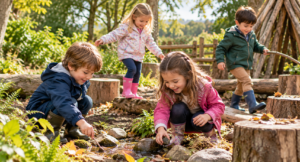 Kate’s new project also arrives during a period when children’s lives are increasingly influenced by digital technology. Screens can provide entertainment, communication, and educational opportunities, but families are also thinking more carefully about how much time children spend sitting and interacting with digital devices.
The World Health Organization’s guidelines for physical activity, sedentary behaviour, and sleep among children under five recognize that children’s entire daily pattern matters. Physical activity, sedentary time, and sleep should be considered together rather than as isolated behaviors.
For families, this does not necessarily mean eliminating technology. Instead, outdoor play can become one part of a broader daily rhythm. A child might watch a short program and later go outside to play, walk, garden, or explore.
Nature can also provide an environment where children are not constantly being directed by a screen. They can decide what to investigate, invent games, move around, and interact with other people.
Why Unstructured Play Can Be Valuable
Not every childhood activity needs a lesson plan. Unstructured play can give children opportunities to make choices and use their imagination.
A stick can become a pretend wand. A group of leaves can become part of a pretend meal. A puddle can become an object of curiosity. A fallen branch can become part of an imaginary obstacle course.
These simple experiences can encourage children to create their own games rather than simply following instructions. UNICEF’s resources on play emphasize that play can support children’s physical, social, cognitive, and emotional development.
Parents do not necessarily need to direct every moment. Sometimes the most valuable role is simply to be nearby, provide a safe environment, and respond when the child wants to share something.
What Parents Can Learn From Kate’s Nature Project
The new initiative is primarily a research and exploration project, so parents should not interpret it as a prescription for a specific number of hours outdoors or a particular parenting method.
Instead, families can take inspiration from the broader idea that children’s environments matter. If a child has regular opportunities to move, explore, ask questions, play, and interact with caring adults, those experiences may become meaningful parts of childhood.
Parents can also choose activities based on their own circumstances. A family in a city might use a local park. Another family might spend time gardening. Someone with limited mobility or outdoor access might use a balcony, window garden, indoor plants, or nature books as complementary experiences.
The emphasis should be on creating opportunities rather than achieving perfection.
How This Connects With Kate’s Broader Work
Kate’s interest in nature has appeared in her work before. The Royal Family’s official material notes her interest in sport and the outdoors and describes the Back to Nature gardens she designed for the 2019 RHS Chelsea Flower Show.
The earlier project highlighted the potential relationship between outdoor environments, exploration, and positive relationships. Her latest initiative takes that interest further by examining nature through the specific lens of early childhood social and emotional development.
It also follows visits to international early-childhood settings, including Denmark and Reggio Emilia in Italy. According to the Centre for Early Childhood, these experiences helped inform Kate’s growing interest in how environments, relationships, creativity, and connection work together during the earliest years.
Readers who enjoy following Kate’s family story can also explore Will & Kate: Love Story for relationship-focused coverage, while the Royal Baby section offers a broader look at royal family and childhood stories.
Why the Cornwall Announcement Matters
The Cornwall announcement is significant because it connects several areas of Kate’s public work: early childhood, relationships, nature, creativity, and wellbeing.
The Centre says the new project will bring together evidence, expertise, and practical experience from different fields to better understand how nature-rich environments can support young children’s development. Further details are expected as the project progresses.
The announcement also reflects the increasingly international nature of early-childhood research. Instead of looking at one model of childcare or education, the project is drawing on different experiences and approaches.
For readers, that makes the project worth following over time. The most interesting developments may come later, when researchers and practitioners begin sharing findings and practical lessons.
What Comes Next for Kate’s Nature Initiative?
The Royal Foundation Centre for Early Childhood has said that further details about the project will be announced in due course. That means the October announcement represents the beginning of a larger piece of work rather than its conclusion.
Future findings could help clarify which aspects of nature-based environments may be most useful for young children, how those environments can be incorporated into childcare and education, and how families with different levels of access to green space can participate.
For families, the most useful development will likely be practical guidance that translates research into realistic everyday experiences.
Final Thoughts
Kate Middleton’s new nature initiative gives her long-running early-childhood work a fresh direction. By exploring how nature-rich environments and nurturing relationships may support social and emotional development, the project brings together two simple but important parts of childhood: the world around children and the people who help them navigate it.
The idea does not require parents to create elaborate outdoor experiences. A walk, a garden, a local park, or a few minutes noticing the natural world can provide an opportunity for curiosity and connection. The important point is to make room for children to explore while giving them supportive relationships along the way.
As the research develops, it may provide more insight into how nature can become a practical part of early childhood. For now, Kate’s latest project offers another example of how her public work continues to focus on the earliest years and the environments in which children grow.
For more coverage, readers can continue exploring Royal Baby stories, browse the Pregnant Kate blog, or revisit your coverage of Prince William’s support for Kate during pregnancy.